


A guide to rear-ported speaker placement

Rear-ported speakers bring high volume at high quality, complete with booming bass. They're undeniably a significant investment into your audio enjoyment, and thus, you want to experience them at their greatest.
To achieve premium performance from your rear-ported speakers, optimal positioning is key. So, in our commitment to bringing you the very best in sonic immersion, we'll unveil expert tips for rear-ported speaker placement for flawless audio enjoyment.
What Are Rear-Ported Speakers?
Ported (also known as bass reflex) speakers are designed to enhance the bass response of a loudspeaker through a series of calculations involving cabinet volume, cabinet filling, and woofer response, among other variables. Typically, bass reflex speakers offer enhanced bass response over closed-box designs.
The downside to ports is that at lower frequencies ‘smearing’ can take place due to the transient response of the design. This smearing is reduced or eliminated through the ‘tuning’ of the port in conjunction with cabinet size and volume, hence the common name ‘tuned-port.’ Another drawback can be the phenomenon known as ‘chuffing’ where air turbulence in the port becomes audible.
A rear-ported speaker can reduce some of this unwanted port noise because the port is positioned away from the listener. Rear-ported speakers can also offer deeper bass but are more sensitive to placement relative to walls compared to front-ported designs, which are more forgiving and versatile in placement due to reduced interaction with rear wall reflections.
Why Placement Matters for Rear-Ported Speakers
The practical issue with a rear-ported speaker is how the energy coming from the cabinet interacts with the boundary behind it. Energy waves bounce off the nearest boundary (for our purposes we’ll call it a “wall”) and interact with the direct energy from the front of the speaker. This interaction may result in either a dip or boost in energy at certain frequencies that will make the overall sound in that frequency region muddy or inarticulate.
There is a school of thought that says rear-ported speakers should never be placed near a wall, and if you are going to place your speakers near a wall, you must always use front-ported or closed-box designs. This is simply false. Are there a few things you can do to optimise the performance of a rear-ported speaker near a wall? Of course, but superlatives are always suspect, especially when it comes to audio.
Best Practices for Rear-Ported Speaker Placement
Rear ported speaker placement all boils down to using the single greatest audio monitoring device ever created – the human ear – and getting your speakers to sound as good as possible before worrying about dialling them in. Forget what the forums say, forget what your audiophile buddy says, forget what you read here – just set your speakers up where you have to set them up because of the room’s design, and then follow a few easy guidelines:
The Angling of a Rear-Ported Speaker
You can change the virtual shape of your room by angling your speakers (toe-in or toe-out). This will not only help with the soundstage but also change the relationship of the rear port to your wall by changing the angle of reflection. It’s important to recognise that your speakers may not always be at the same angle as each other—rooms are not always symmetrical, so it stands to reason the angle of your speakers needs to compensate for that.
Our speaker setup guide can provide you with further angling advice.
Acoustic Treatments for Rear-Ported Speakers
You can add a little dampening material behind the speaker but be careful: there is no worse-sounding room than an overly dampened one. The best way to treat reflection problems is through dispersion.
You can also experiment with the port bungs or tubes. These are meant to cut down on the energy leaving the port or to reduce the energy ‘piling up’ behind the speaker.
How Far Should Rear-Ported Speakers Be from the Wall?
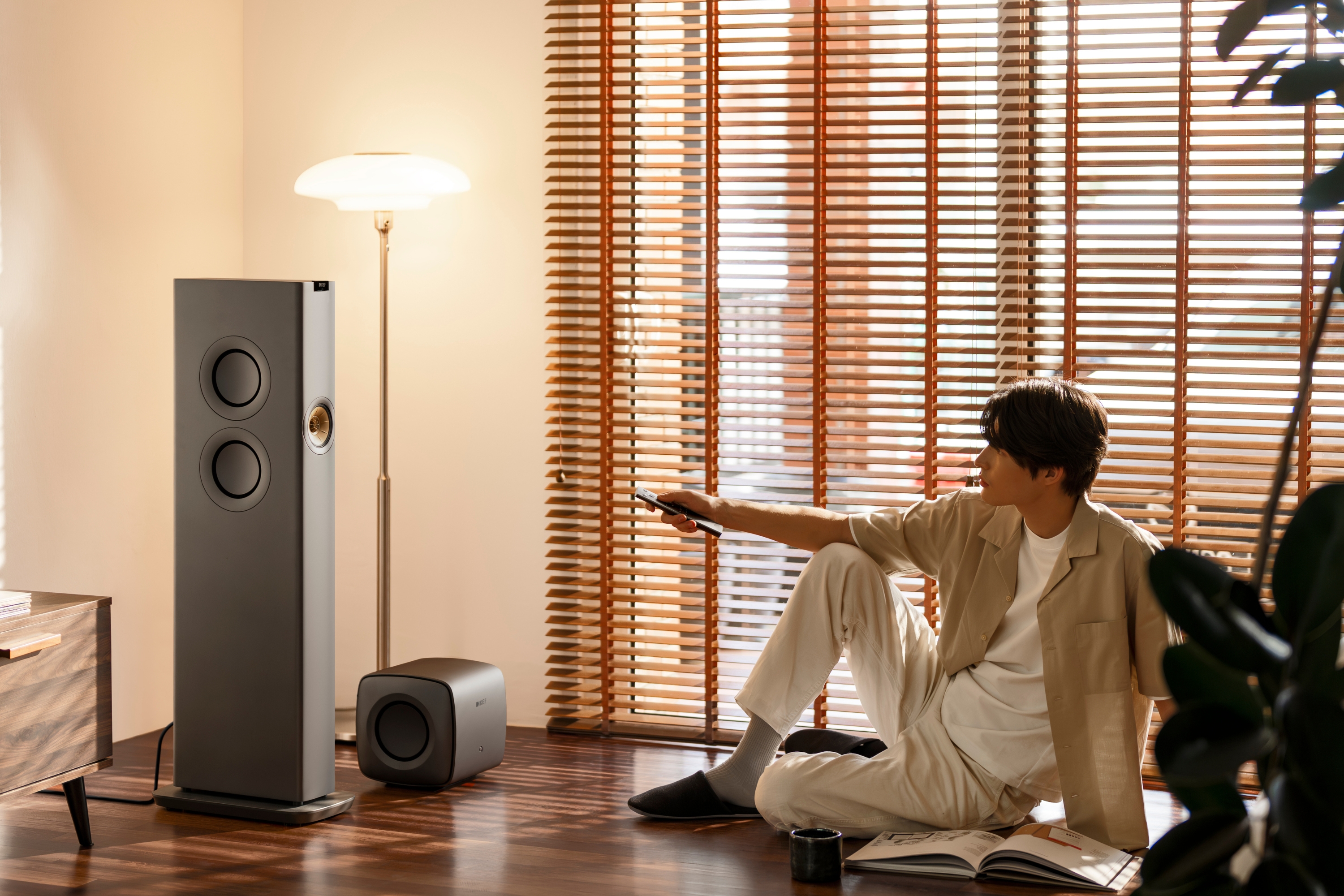
Whether you are using stands for your bookshelf speakers or floorstanding Speakers, the wall behind the loudspeaker can greatly affect bass response. The wall reflects the omnidirectional energy emanating from the loudspeaker and the energy from the port itself. For our purposes, we’ll ignore the omnidirectional energy from the cabinet, as in most home setups, that energy is small (especially if you have a quality-designed loudspeaker).
When sound energy leaves a port and interacts with the rear wall, two things occur: 1) certain frequencies get boosted, and 2) certain frequencies get cut.
When a frequency is boosted (sympathetic resonance), it adds to the energy of the original (direct) frequency, causing an artificial increase in sound at that frequency (too much bass). When that frequency is slightly time-smeared (typically arriving after the direct energy from the front), the result is a muddy, inarticulate sound.
A frequency gets attenuated after it destructively interacts (out of phase) with the direct energy, causing the direct and reflected energies to cancel (not enough bass). This happens when frequencies arrive at the ear out of phase with each other due to the interaction between the wall, the port, and the distance to the listener (among other factors).
In small living spaces, it's advisable to keep rear-ported speakers at least 15-30 cm away from walls and to experiment with positioning to balance bass response and minimise room interactions.
Further is not always better
Further is usually better, but don’t ignore the improvements that can be made by moving the speakers closer to the wall. It seems counterintuitive, but depending on which frequencies present the trouble, moving the speakers closer to the wall may clean up some reflections. Too close a placement can lead to an exaggerated bass response, potentially causing boominess.
Generally, a distance of 0.85 metres between the speaker and the wall will eliminate low-frequency cancellation issues. However, if this is not possible, other options exist.
Tips for Optimising Bass Response in Rear-Ported Speakers
Moving speakers further or closer to the wall will often reduce frequency pile-up, but it can also affect which frequencies are cut. The closer the speakers are to the wall, the higher the affected frequency, and the further away, the lower. A small move can make a huge difference, so it’s best to go a few centimetres or degrees at a time.
Using room treatments or adjusting placement can mitigate excessive reflections or distortion. One such treatment is bass traps, acoustic panels designed to absorb low-frequency sound waves. Identify areas and corners where bass waves accumulate and apply bass traps to ensure even distribution.
Choose cutting edge speakers and subwoofers with KEF today, and explore our blog for more expert advice on enhancing their performance.


